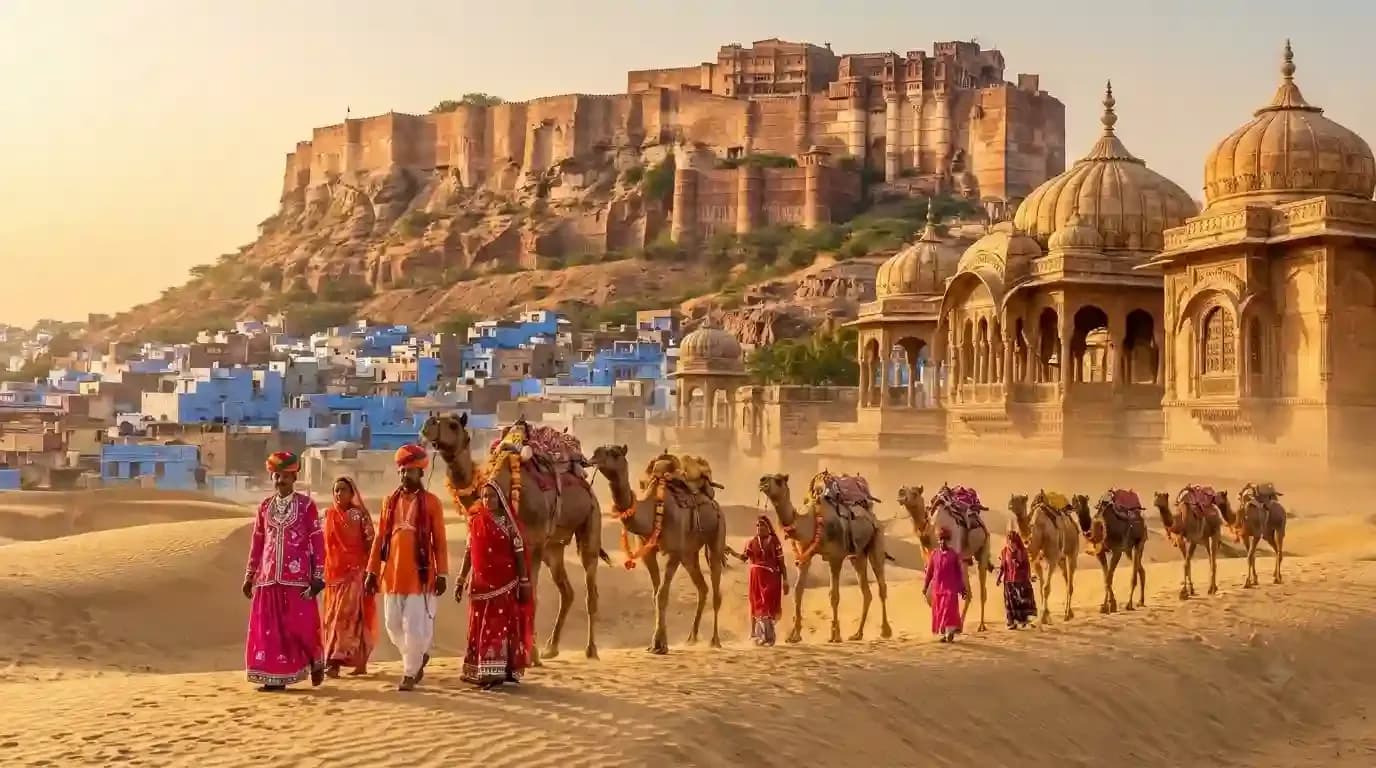
Rajasthan is too big for one trip, and most people work this out halfway through theirs. There are more places to visit in Rajasthan than any seven-day route can hold, so it helps to think of the state as three directions out of Jaipur: south to Udaipur, west to Jodhpur and Jaisalmer, north to Bikaner. Pick one and you will actually enjoy it.
Rajasthani cuisine changes as you move. The desert west cooks around what survives there — dried beans, millet, a lot of ghee, very little fresh vegetable. The south, sitting closer to Gujarat and Malwa, eats lighter and sweeter. A Rajasthani thali in Bikaner does not taste like one in Udaipur. That difference is half the reason to travel this state by road instead of flying between two cities.
Jaipur
Most trips begin here, and two days is the honest minimum. Amber Fort takes a half-day on its own — go early, before the buses. The City Palace, Jantar Mantar and Hawa Mahal sit within walking distance of each other in the old city, so club them into one morning. Nahargarh at sunset is worth the drive up.
Famous food in Jaipur: pyaaz kachori is the one to try first — onion filling, fried, served hot with chutney, eaten standing at the counter. Ghevar turns up everywhere during Teej and Sawan, less so the rest of the year. If you eat meat, laal maas belongs on the table. Jaipur also does a proper dal baati churma, though you will find better versions further west.
Jodhpur
Mehrangarh is the reason to come, and it earns the hype — the fort sits on a rock face above the city and the audio tour is one of the better ones in India. Jaswant Thada is a ten-minute walk away. Umaid Bhawan is partly a museum, partly still a palace hotel. The blue houses are concentrated in the lanes below the fort, around Navchokiya.
What to eat in Jodhpur: mirchi bada, a whole chilli in batter, fried. It sounds alarming and is milder than it looks. Mawa kachori is the sweet version — stuffed with khoya, soaked in syrup. Makhaniya lassi is thick enough to count as a meal, and the stalls near the clock tower and Sardar Market are where people queue.
Udaipur
Slower than the rest of Rajasthan, and the one city where people tend to add a day. The City Palace complex runs along Lake Pichola and takes longer than you expect. Boat across to Jag Mandir in the late afternoon. Saheliyon ki Bari and Fateh Sagar fill a second day without much effort.
Famous food in Udaipur: this is dal baati churma country, and the Mewari version is the benchmark — baati cracked open, drowned in ghee, eaten with both dals and the sweet crumbled churma. Gatte ki sabzi, gram-flour dumplings in a yoghurt gravy, is the dish to order when you want something that is not fried. Laal maas here is usually cooked with Mathania chillies, so it reads smoky rather than just hot.
Pushkar and Ajmer
These two sit about 15 km apart and work as a single stop. Pushkar has the Brahma Temple — one of very few anywhere — and a lake ringed by ghats. Climb to Savitri Temple for the view if you are up early. Ajmer is built around the Dargah Sharif, which draws pilgrims year-round.
One practical thing worth knowing: Pushkar is a temple town, and meat, eggs and alcohol are not served inside it. Plan your meat meals for Ajmer or further along the route.
Pushkar local food: malpua, from the stalls along the main bazaar — fried, syrup-soaked, best eaten warm. The best food in Ajmer sits around the dargah, and the city is known for sohan halwa, dense and ghee-heavy, which travels well if you want to carry something home.
Jaisalmer
Five to six hours west of Jodhpur by road. Jaisalmer Fort is one of the few living forts left — people still live, cook and run shops inside the walls. Patwon ki Haveli is the best preserved of the merchant houses. Most visitors do a night at Sam or Khuri dunes; the Sam side is busier, Khuri quieter. Kuldhara, the abandoned village on the way, is a short detour.
Jaisalmer food speciality: ker sangri, a dry mix of desert berries and beans, is the dish that explains the region — nothing in it needs fresh water to grow. Eat it with bajre ki roti rather than wheat. Gatte and kadhi show up on most thalis here too, for the same reason: both keep without refrigeration.
Bikaner
The least crowded of the big Rajasthan cities. Junagarh Fort is unusual in that it was never built on a hill, and the interiors are better preserved than most. Karni Mata Temple at Deshnoke, about 30 km out, is the rat temple — go only if the idea appeals. The Rampuria Havelis in the old city are easy to walk between.
Bikaner famous sweets and snacks: Bikaneri bhujia, obviously, and it is worth buying from the old shops rather than a packet at the station. Less well known outside the state: Bikaner makes a very good rasgulla, and the kachoris here run spicier than Jaipur's.
Bundi, if you have an extra day
Bundi sits between Jaipur and Udaipur and most itineraries skip it. It has stepwells — Raniji ki Baori is the one people photograph — and the Bundi Palace murals, which are some of the best surviving examples of Rajput wall painting. Taragarh Fort above the town is largely unrestored, which is part of the appeal. Food here is standard Hadoti fare rather than anything distinct, so come for the architecture.
Planning notes
When to go. October to March. Days are pleasant, nights get genuinely cold in the desert from December, so carry a jacket for Jaisalmer and Bikaner. April to June is hot enough to ruin a trip — 45°C is normal. The monsoon is short and mostly fine in the south.
How long. Six to seven days covers the top destinations in Rajasthan — Jaipur, Jodhpur and Udaipur — comfortably. Adding Jaisalmer pushes it to nine or ten, because the drives are long. Trying to do all five big cities in a week means spending the week in a car.
Getting around. Roads between the major cities are good and self-drive or a hired car works well. Overnight trains link Delhi, Jaipur, Jodhpur and Jaisalmer and save a day. At Miles to Go we usually build routes in one direction rather than looping back through Jaipur — it cuts several hours of repeat driving.
Eating. Rajasthani food is heavy on ghee and chilli. If you are not used to it, start with one rich meal a day rather than three. Street food is safest where there is turnover — a stall with a queue is a better bet than an empty one.
FAQs
What is the famous food of Rajasthan?
Dal baati churma is the dish most associated with the state. Beyond it: laal maas, gatte ki sabzi, ker sangri, and regional specialities like mirchi bada in Jodhpur and bhujia in Bikaner.
Which city in Rajasthan is best for food?
Jodhpur, for variety and for how much of it is street food. Jaipur is a close second and easier if you want restaurants rather than stalls.
How many days are enough for a Rajasthan trip?
Six to seven days for Jaipur, Jodhpur and Udaipur. Nine to ten if you want Jaisalmer as well.
What is the best time to visit Rajasthan?
October to March. December and January are coldest at night, especially in the desert districts.
What to eat in Rajasthan in winter?
Winter is when the heavier dishes make sense. Dal baati churma, laal maas and gatte ki sabzi all suit cold weather, and hot kachoris and sesame-based sweets are easier to find from December onwards.
Is Rajasthani food always spicy?
Much of it is, but not all. Gatte ki sabzi, kadhi, and most of the sweets are mild. You can ask for less chilli at most places and it is not treated as an odd request.
Can vegetarians eat well in Rajasthan?
Yes — a large share of the state's best-known food is vegetarian, and Pushkar is entirely so. Finding good vegetarian food is easier here than finding good meat outside the big cities.
Which Rajasthan city should I start with?
Jaipur, for the flight and train connections. From there pick one direction and commit to it.
Continue planning
Related planning guides
10 Best Places to Visit in Dalhousie for a Memorable Hill Station Trip
Practical trip insights and route guidance.
North Sikkim Tour: Explore Scenic Valleys, Snow-Capped Mountains & Stunning Lakes
Practical trip insights and route guidance.
Why Winter Is the Best Time to Explore Rajasthan: Food, Culture & Places to Visit
Practical trip insights and route guidance.